
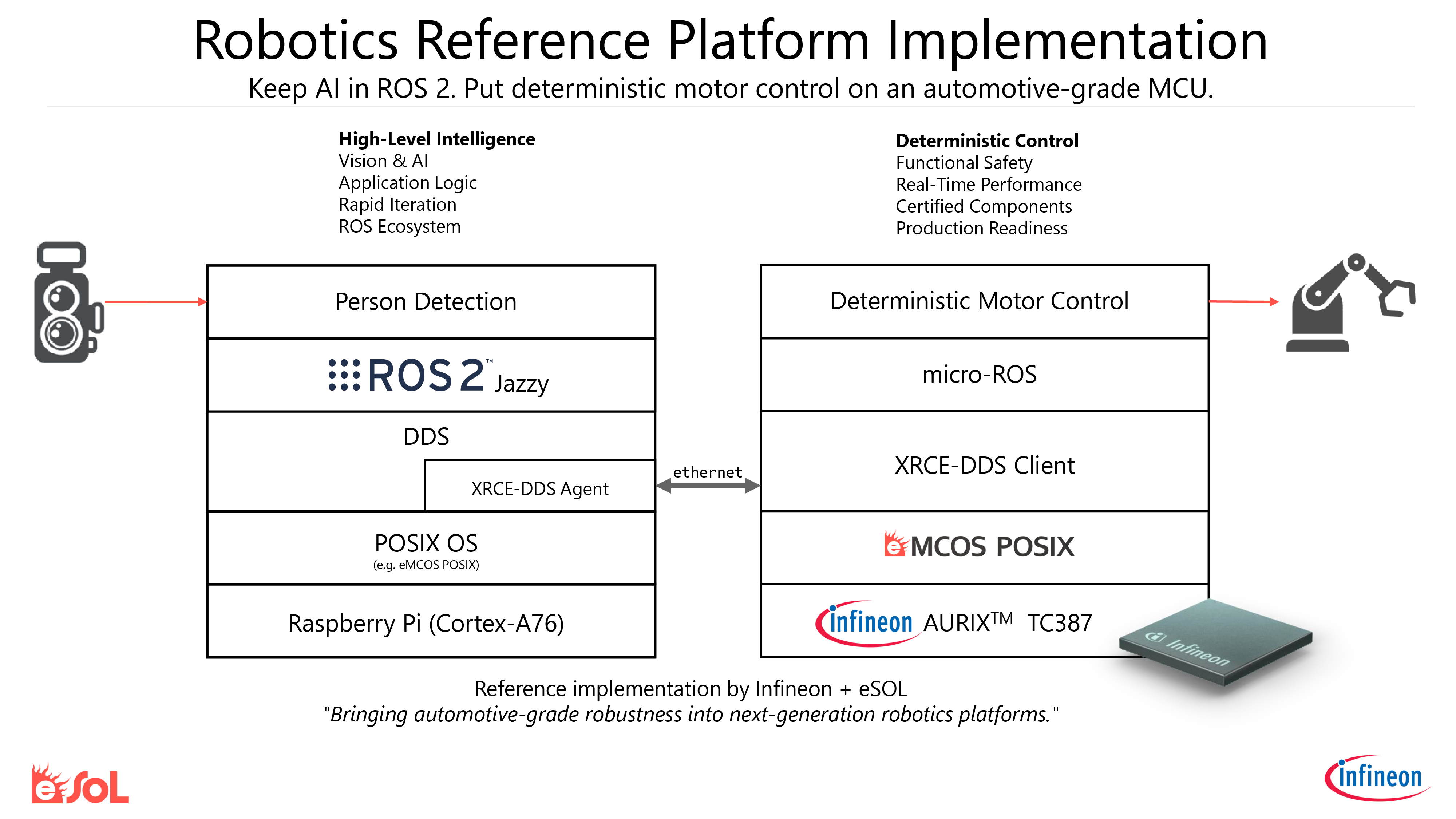
At electronica 2026, eSOL and Infineon will demonstrate a Robotics Reference Platform that keeps AI in ROS 2 and puts deterministic motor control on an automotive-grade microcontroller. A Raspberry Pi (Cortex-A76) runs Person Detection in ROS 2 Jazzy, while an Infineon AURIX TC387 running eSOL eMCOS POSIX controls the motor. The two sides exchange data over ethernet using XRCE-DDS.
The Robotics Reference Platform is a reference implementation by Infineon and eSOL. It divides the robot into two parts, each running on hardware suited to its job.
High-level Intelligence runs on a Raspberry Pi (Cortex-A76) with eMCOS POSIX. This is where Vision & AI and Application Logic live. Because it stays in the ROS Ecosystem, developers can keep improving and testing quickly.
Deterministic Control runs on an Infineon AURIX TC387 with eMCOS POSIX. This is where Deterministic Motor Control runs. It is built for Real-Time Performance and Functional Safety, using Certified Components, with Production Readiness in mind.
How the Demonstration Works
- A camera provides the video input.
- Person Detection runs in ROS 2 Jazzy on the Raspberry Pi (Cortex-A76).
- The results go through DDS to the XRCE-DDS Agent, which sends them over ethernet.
- On the AURIX TC387, the XRCE-DDS Client receives the results and passes them to micro-ROS.
- Deterministic Motor Control, running on eMCOS POSIX, uses them to drive the motor.
Components
|
Component |
Provider |
Role in the Demo |
|
AURIX TC387 |
Infineon |
Microcontroller for Deterministic Motor Control |
|
eMCOS POSIX |
eSOL |
Real-time operating system on the Raspberry Pi and the TC387 |
|
ROS 2 Jazzy |
Open source |
Robotics framework for Person Detection |
|
Raspberry Pi (Cortex-A76) |
Raspberry Pi |
Host for ROS 2 and Person Detection |
|
XRCE-DDS Agent and Client |
Open source |
Exchange data between the Raspberry Pi and the TC387 over ethernet |
|
DDS |
Standard middleware |
Middleware for data exchange in the ROS 2 environment |
|
Camera |
Not specified |
Video input |
|
Motor |
Not specified |
Output controlled by Deterministic Motor Control |
Benefits
- Rapid Iteration: Vision & AI and application logic stay in the ROS Ecosystem.
- Real-Time Performance: Deterministic Motor Control runs on a dedicated microcontroller, independent of vision and AI workload changes.
- Functional Safety: Deterministic Control is built on automotive-grade hardware and software technologies designed for safety-conscious applications.
- Certified Components: eMCOS POSIX ver3.0 is certified up to ASIL D as a SEooC under ISO 26262:2018 (SGS-TÜV Saar, September 2025).
- Production Readiness: The architecture bridges the gap between robotics prototyping and industrial deployment.
- Scalability: One host can control multiple AURIX nodes.
Use Cases
Industrial robots
Service robots
Autonomous machines
Frequently Asked Questions
Why separate High-Level Intelligence from Deterministic Control?
Vision & AI workloads on a high-performance processor change processing load and timing. A dedicated microcontroller with a real-time OS keeps Deterministic Motor Control independent of that load.
What is micro-ROS?
It brings ROS 2 concepts to microcontrollers. In this platform it runs on the AURIX TC387 and connects Deterministic Control with the ROS 2 environment.
What is XRCE-DDS?
It is a DDS protocol for resource-constrained devices. In this platform an XRCE-DDS Agent on the Raspberry Pi and an XRCE-DDS Client on the AURIX TC387 exchange data over ethernet.
What is eMCOS POSIX?
It is a real-time operating system from eSOL with a POSIX interface. In this platform it runs on both the Raspberry Pi (Cortex-A76) and the AURIX TC387.
Is the platform safety certified?
The operating system is certified. eMCOS POSIX ver3.0 holds an ASIL D certification as a SEooC under ISO 26262:2018, issued by SGS-TÜV Saar. See the eSOL press release for details.
What does SEooC mean?
Safety Element out of Context means the OS was developed and certified as a reusable component, not for one specific vehicle. Integrators confirm that it fits their own system's safety requirements.
See it at Electronica 2026
Visit the Infineon booth at electronica 2026 in Munich, Germany: Hall C3, Booth 502. The demonstration is shown on the Infineon partner wall. The show runs from November 10 to November 13, 2026, from 09:00 to 18:00 CET.
Talk to eSOL
ROS 2 keeps development fast, and eMCOS POSIX on AURIX keeps motor control deterministic. If you are planning a robotics system with this kind of split, we'd be glad to talk.

E.O.
Marketing Communications Team
* eSOL and eMCOS are registered trademarks or trademarks of eSOL Co., Ltd. in Japan and other countries.
* Other company or product names are trademarks or registered trademarks of their respective companies.
Abbreviations
- AI: Artificial Intelligence
- ASIL: Automotive Safety Integrity Level
- DDS: Data Distribution Service
- POSIX: Portable Operating System Interface
- ROS 2: Robot Operating System 2
- SEooC: Safety Element out of Context
- XRCE-DDS: DDS for eXtremely Resource Constrained Environments


